

When you are buying a property in India, there will be several tax liabilities in the form of property registration charges which you must pay to become the legal owner of the property.
Understanding the key terms in these government fees is important. We have curated this easy and simple guide blog for you to understand these terms in a very basic manner. Read further to learn more.
What are property registration charges?
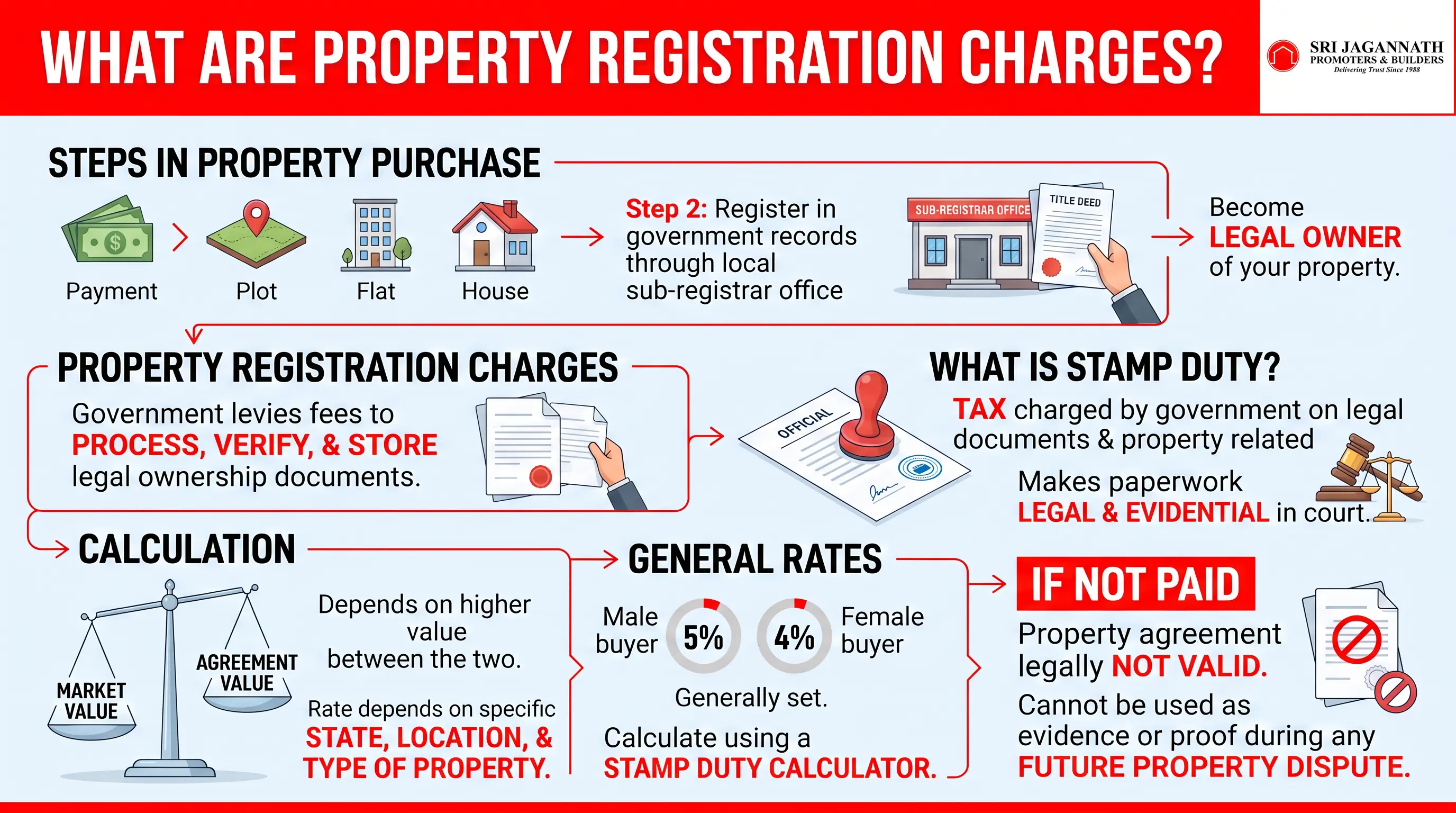
In India, when you are purchasing a plot, flat, or house, the payment made to the seller is only the first step.
The second step is registering your plot, flat, or house in government records through the local sub-registrar office. You do this to become the legal owner of your property.
When registering your property with the government, it levies some fees to process, verify, and store the legal ownership documents. This fee is called property registration charges.
What is stamp duty?
Stamp duty is a tax charged by the government on legal documents and property related transactions. This is important so as to make the paperwork legal and evidential in court.
A stamp duty is calculated as a percentage of a property’s market value or agreement value. It depends on the higher value between the two. This rate is dependent on the specific state, location, and type of property.
If you don’t pay the stamp duty to the government, your property agreement is legally not valid, and cannot be used as evidence or proof during any property dispute arising in the future.
Generally, stamp duty is set at 5% for male buyers of property and 4% for female buyers of property.
You can calculate stamp duty of a particular state using a stamp duty calculator.
What is “TDS” when purchasing property in India?
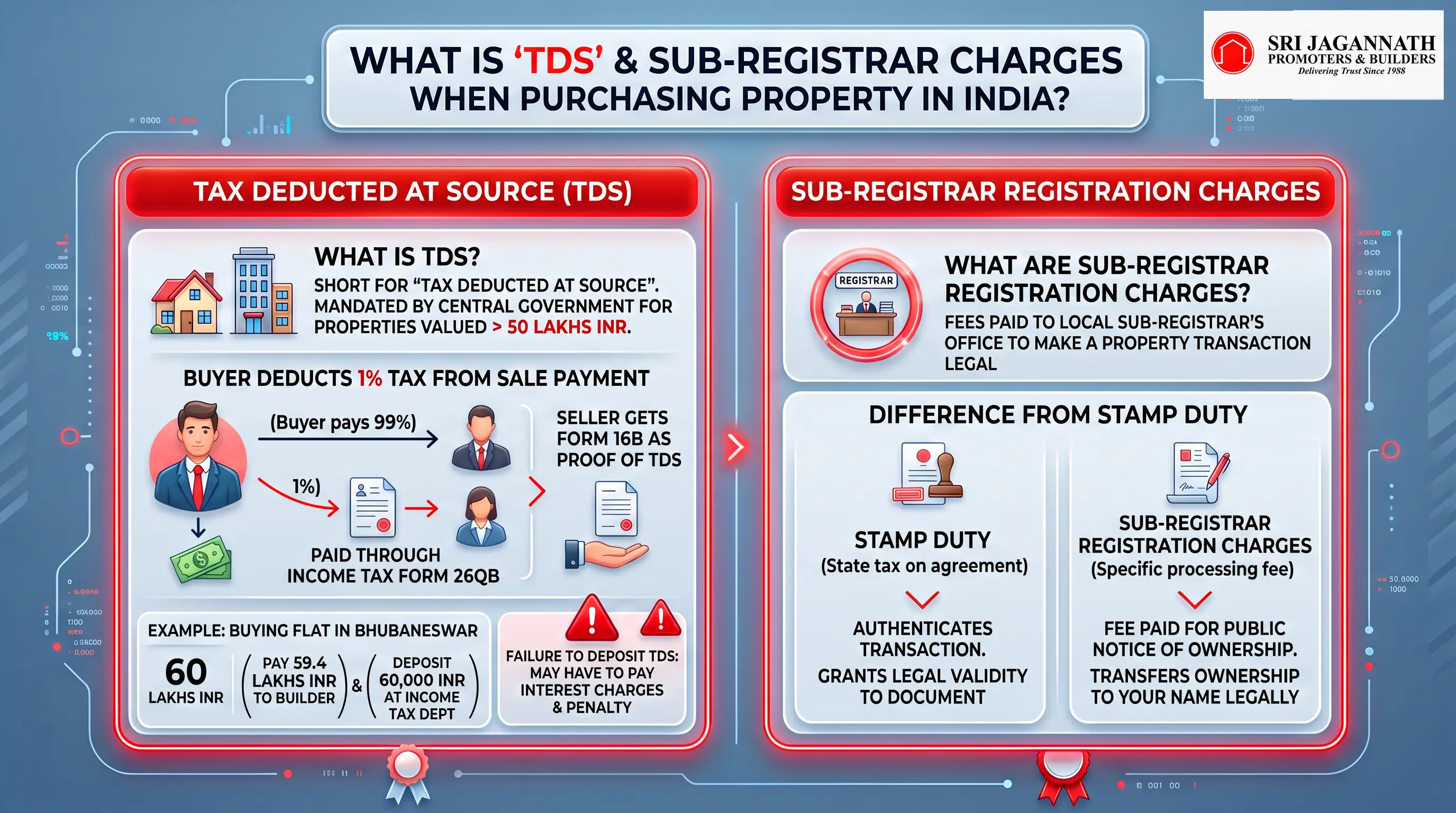
TDS is short for “Tax Deducted at Source”. This tax is mandated by the central government for residential, or commercial properties which are valued more than 50 lakhs INR.
In such a case, the income tax department requires the buyer to deduct 1% tax directly from the sale payment.
This tax must be paid through the Income Tax Form 26QB. And the seller, from whom you bought the property, must be provided with a Form 16B as proof of the TDS.
For example, if you buy a flat in Bhubaneswar for 60 lakhs INR, you must pay 59.4 lakhs INR to the builder or seller, and deposit 60,000 INR at the Income Tax Department.
If you fail to deposit the TDS, you may have to pay interest charges on penalty.
What are sub-registrar registration charges?
Sub-registrar registration charges are the fees paid to the local sub-registrar’s office to make a property transaction legal.
It is different from Stamp Duty since it is the specific processing fee paid to the sub-registrar of a particular state to transfer the ownership of the property to your name legally.
While Stamp Duty is a state tax paid on the agreement itself to authenticate the transaction of the property transfer.
Stamp duty grants legal validity to the document of transaction of a property between a buyer and seller. But sub-registration charge is a fee paid for the public notice of ownership.
What are post-purchase taxes after property registration charges?
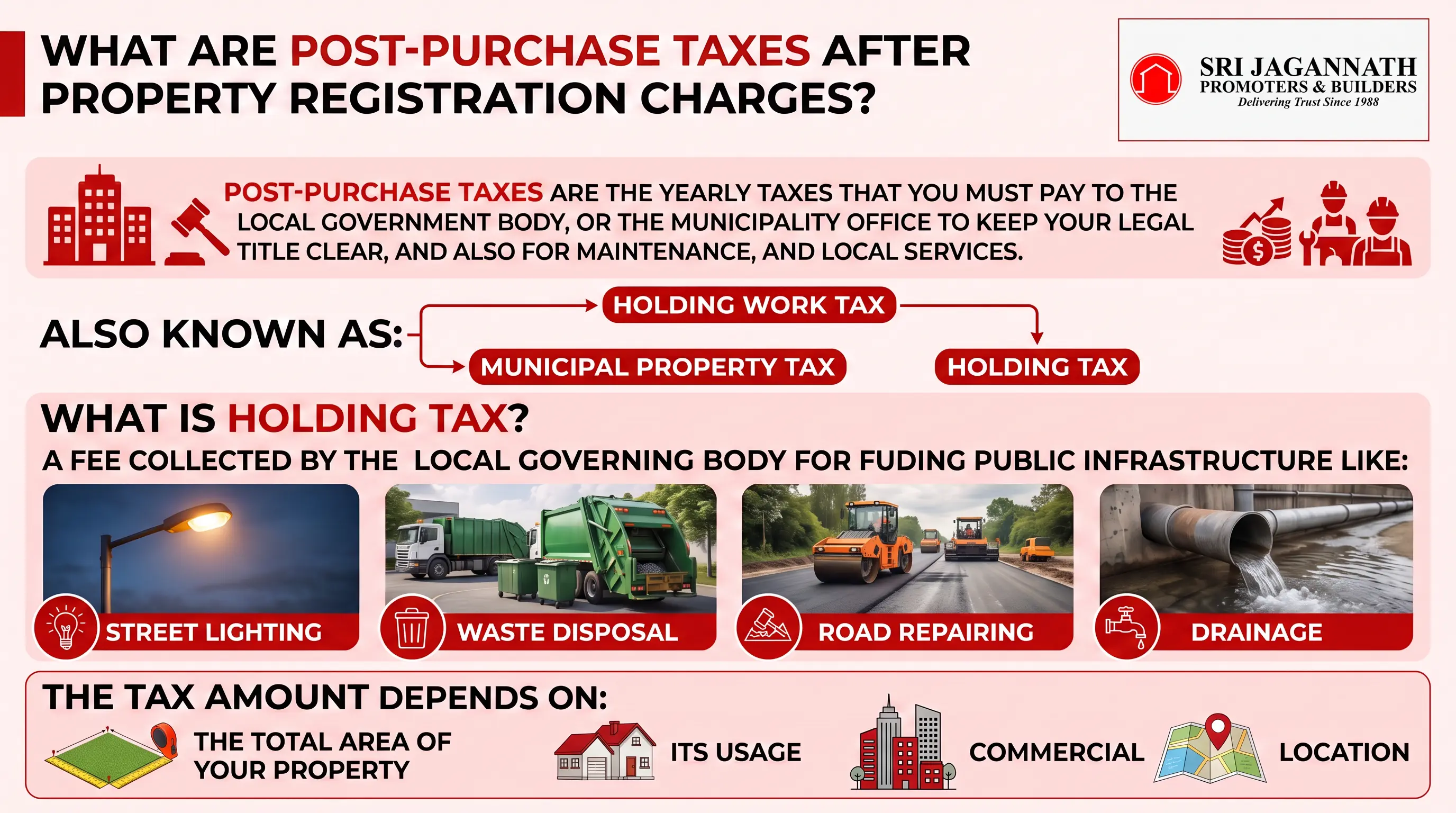
Post-purchase taxes are the yearly taxes that you must pay to the local government body, or the municipality office to keep your legal title clear, and also for maintenance, and local services.
This is also known as the municipal property tax, or holding tax.
What is holding tax?
A holding tax is a fee collected by the local governing body for funding public infrastructure like street lighting, waste disposal, road repairing, and drainage.
The tax amount depends on the tidal area of your property, its usage, and location.
What is a “Circle Rate” in property registration charges?
The circle rate is also known as benchmark value in Odisha.
It is the minimum price fixed by the government, below which a property cannot be legally registered in a specific area.
It is reviewed and regularly updated by the state revenue departments based on location, road connectivity, local developments, and property types.
How does circle rate decide your property registration charges?
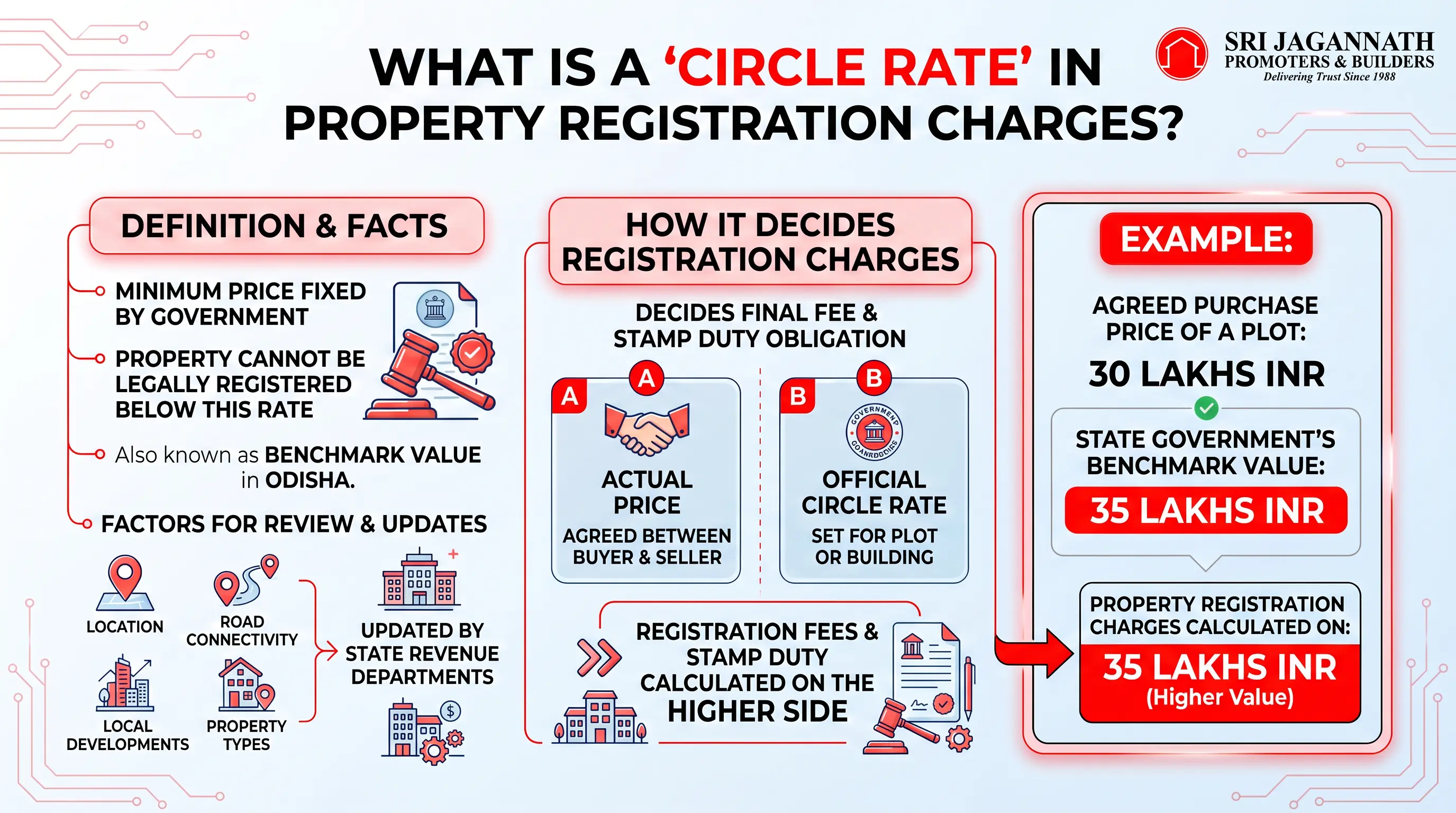
The role of circle rate in property registration charges is deciding the final fee and stamp duty obligation to the government.
Two numbers are generally evaluated by the government when you buy a property in India:
One is the actual price of the property agreed between you and the seller. Second is the official circle rate set for that plot or building by the government.
According to the rules of the government, registration fees and stamp duty is always calculated on the value which is on the higher side.
For example, if you agree to purchase a plot for 30 lakhs INR, but the state government’s benchmark value for that area is set at 35 lakhs INR, then your property registration charges will be calculated on the 35 lakhs INR (higher value).
Overview of Key Terms
Here is the table summarizing the key real estate terms covered in the blog:
| Terms | Meaning |
|---|---|
| Property Registration Charges | The fee which you pay to the sub-registrar office to record your property in the government database. It makes your property transaction legal, as well as makes you the legal owner. |
| Stamp Duty | It is a state tax paid on your sale agreement to make the paperwork legally valid as proof in a court of law. |
| Sub-Registrar Registration Charges | It is the specific administrative processing fee paid directly to the local sub-registrar’s office for the transfer of ownership to yourself. |
| Circle Rate | It is the minimum price per square foot set by the government for an area. If your purchase price is lower, taxes are still calculated on this rate. |
| TDS (Tax Deducted at Source) | It is a 1% central tax that the buyer must deduct from the seller’s payment and deposit at the Income Tax Department. It is specifically for properties worth ₹50 lakhs or more. |
| Holding Tax (Municipal Property Tax) | It is an annual tax paid to your local municipal body to maintain street lights, roads, drainage, and waste collection around your property as maintenance and repair charges. |
Conclusion
Buying a home in India is an important life milestone for many Indians. Therefore, it is very important that you understand and stay aware of the different terms like stamp duty, TDS on property purchase, holding tax, circle rate, etc.
When you keep yourself aware about these mandatory government charges, you will be safe from any future legal disputes related to your property.
If you liked reading our blog, consider checking out our other blogs.
Frequently Asked Questions (FAQs)
1. How are property registration charges calculated in Odisha?
In Odisha, property registration charges are dependent on the property’s market value or circle rate. The total property registration fee also includes a 2% registration fee and a stamp duty.
2. What is the current stamp duty rate for women in Odisha?
In Odisha, the stamp duty rate for female buyers is set at 4% to encourage female property ownership.
3. Can I check my property tax costs before buying?
Yes you can. You can either use a stamp duty calculator available on state government portals to estimate your exact legal taxes and fees, or check the taxes levied by the local municipal body online.
4. Do I always have to pay TDS on property purchase?
No you do not always need to pay TDS on property purchase. You only pay a 1% TDS on property purchase if the total sale value is ₹50 lakh or more.
5. Are sub registrar registration charges the same for men and women?
Yes, the sub registrar registration charges are fixed for men and women, at 2% of the property’s value.
6. Do I need to pay any tax after property registration?
Yes you still need to pay municipal taxes after registering your property. This is called the annual holding tax for maintenance and repairs in your locality.
7. What happens if my purchase price is lower than the circle rate?
According to government rules, property registration charges must be calculated on the higher amount between your actual purchase price and the official circle rate. Thus, you will have to pay taxes on the higher value set by the government.
8. Who is responsible for paying the stamp duty and registration fees?
Generally, the buyer is responsible for paying the property registration charges and stamp duty to transfer the property title into their legal name.
9. Is it mandatory to register a property immediately after buying?
Yes, you must register the sale deed within four months of signing it. If you delay this process it will lead to heavy monetary penalties and legal risks.
10. Can I claim tax benefits on property registration fees?
Yes you can under Section 80C of the Income Tax Act. You can claim tax deductions on the stamp duty and property registration charges paid during the purchase.








Leave a Reply