
Buying a home or a plot of land is a major milestone, but the legal jargon can feel overwhelming. Understanding the essential Property Documents and Legal Terms in Odisha is critical to protecting your hard-earned money.
In this guide, we break down complex real estate terms into simple, easy-to-understand explanations. Here is everything you need to know before signing any property deal Property Documents and Legal Terms
1.What Is A Sale Deed, And Why Is It The Most Important Land Ownership Document In Odisha?
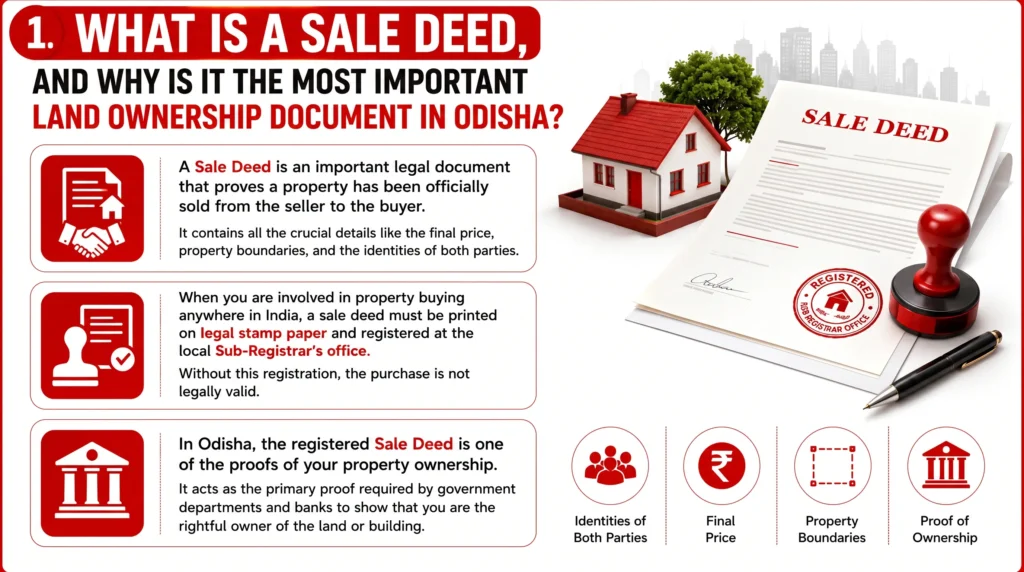
A Sale Deed is an important legal document that proves a property has been officially sold from the seller to the buyer. It contains all the crucial details like the final price, property boundaries, and the identities of both parties Property Documents and Legal Terms.
When you are involved in property buying anywhere in India, a sale deed must be printed on legal stamp paper and registered at the local Sub-Registrar’s office. Without this registration, the purchase is not legally valid.
In Odisha, the registered Sale Deed is one of the proofs of your property ownership. It acts as the primary proof required by government departments and banks to show that you are the rightful owner of the land or building.
2.What Is A Title Deed, And How Does It Prove I Own A Property?
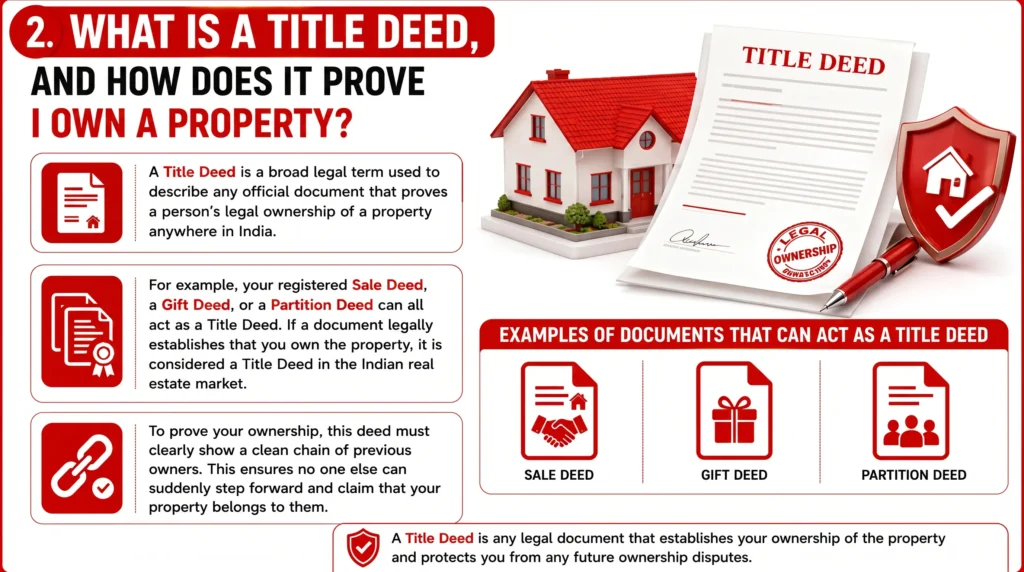
A Title Deed is a broad legal term used to describe any official document that proves a person’s legal ownership of a property anywhere in India.
For example, your registered Sale Deed, a Gift Deed, or a Partition Deed can all act as a Title Deed. If a document legally establishes that you own the property, it is considered a Title Deed in the Indian real estate market & Property Documents and Legal Terms.
To prove your ownership, this deed must clearly show a clean chain of previous owners. This ensures no one else can suddenly step forward and claim that your property belongs to them.
3.What Is A Conveyance Deed, And How Is It Different From A Sale Deed?
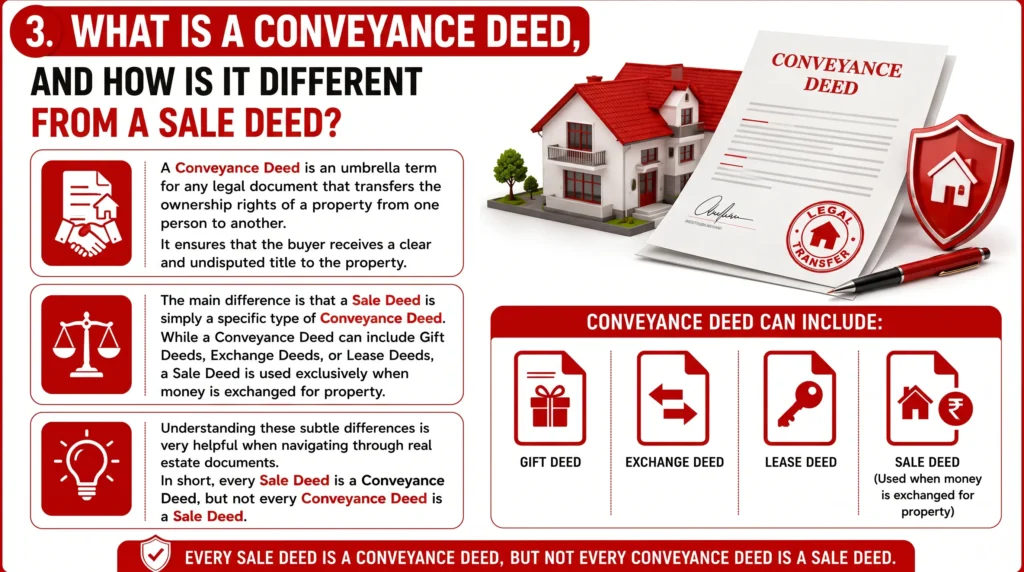
A Conveyance Deed is an umbrella term for any legal document that transfers the ownership rights of a property from one person to another. It ensures that the buyer receives a clear and undisputed title to the property.
The main difference is that a Sale Deed is simply a specific type of Conveyance Deed. While a Conveyance Deed can include Gift Deeds, Exchange Deeds, or Lease Deeds, a Sale Deed is used exclusively when money is exchanged for Property Documents and Legal Terms.
Understanding these subtle differences is very helpful when navigating through real estate documents. In short, every Sale Deed is a Conveyance Deed, but not every Conveyance Deed is a Sale Deed.
4.What Is An Agreement To Sell, And Does It Give Me Legal Ownership?
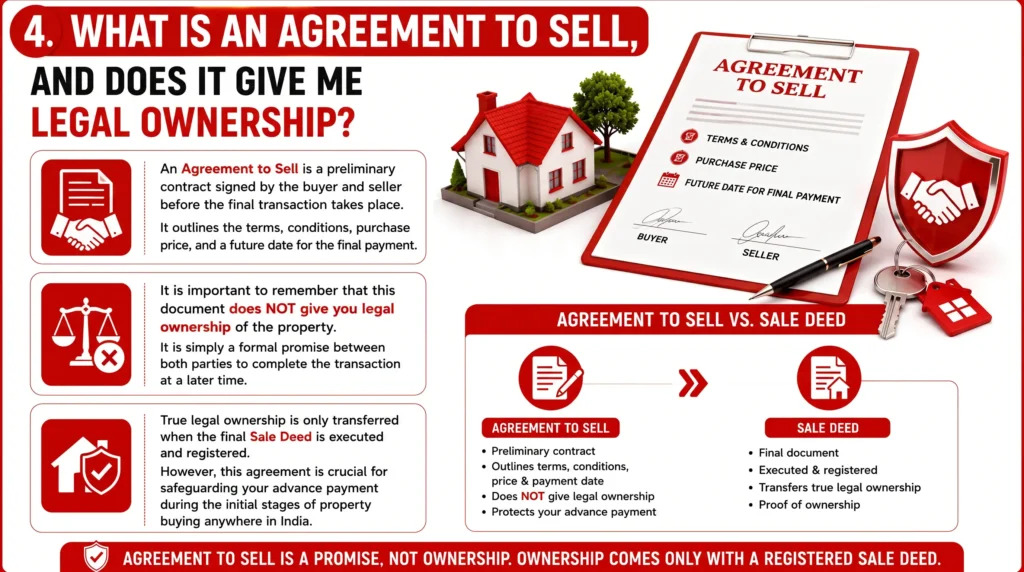
An Agreement to Sell is a preliminary contract signed by the buyer and seller before the final transaction takes place. It outlines the terms, conditions, purchase price, and a future date for the final payment.
It is important to remember that this document does NOT give you legal ownership of the property. It is simply a formal promise between both parties to complete the transaction at a later time.
True legal ownership is only transferred when the final Sale Deed is executed and registered. However, this agreement is crucial for safeguarding your advance payment during the initial stages of property buying anywhere in India Property Documents and Legal Terms.
5.What Is RoR (Record Of Rights) / Khatiyan, And Why Is It Mandatory As A Land Ownership Document In Odisha?
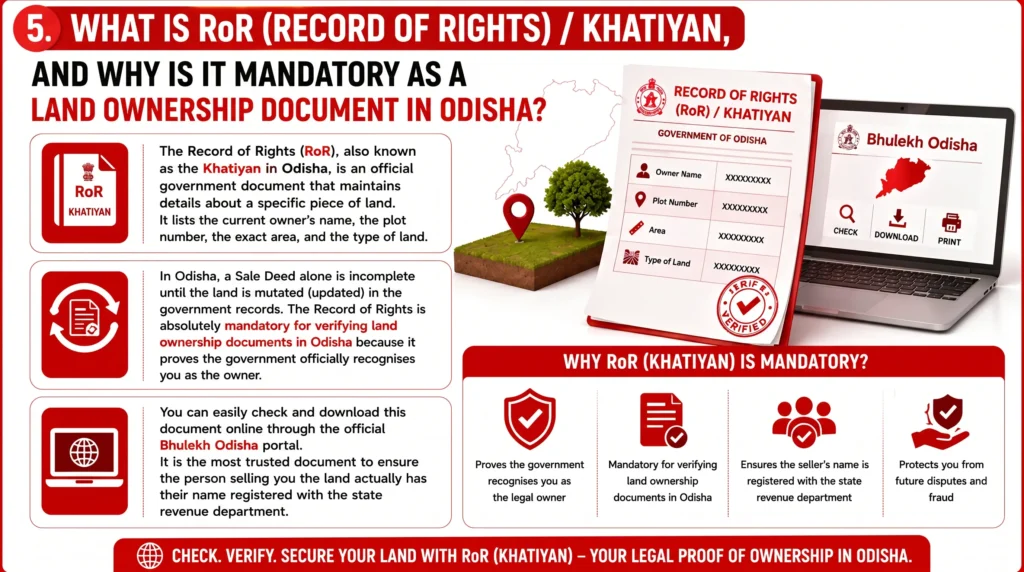
The Record of Rights (RoR), also known as the Khatiyan in Odisha, is an official government document that maintains details about a specific piece of land. It lists the current owner’s name, the plot number, the exact area, and the type of land.
In Odisha, a Sale Deed alone is incomplete until the land is mutated (updated) in the government records. The Record of Rights is absolutely mandatory for verifying Property Documents and Legal Terms in Odisha because it proves the government officially recognises you as the owner.
You can easily check and download this document online through the official Bhulekh Odisha portal. It is the most trusted document to ensure the person selling you the land actually has their name registered with the state revenue department.
6.What Is An Encumbrance Certificate (EC), And How Do I Check It Online Through The Inspector General Of Registration (IGR) In Odisha?
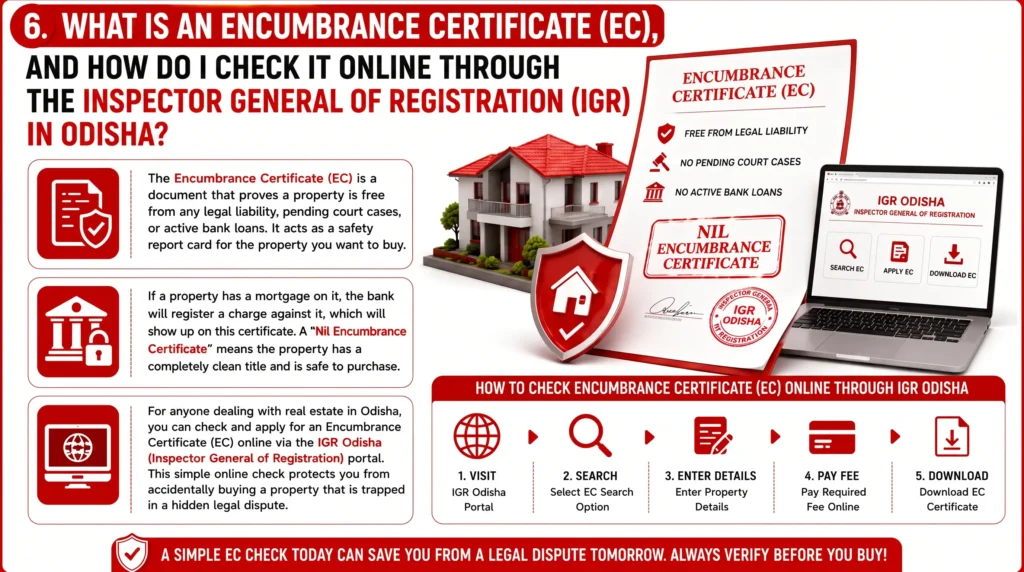
The Encumbrance Certificate (EC) is a document that proves a property is free from any legal liability, pending court cases, or active bank loans. It acts as a safety report card for the property you want to buy.
If a property has a mortgage on it, the bank will register a charge against it, which will show up on this certificate. A “Nil Encumbrance Certificate” means the property has a completely clean title and is safe to purchase.
For anyone dealing with real estate in Odisha, you can check and apply for an Encumbrance Certificate (EC) online via the IGR Odisha (Inspector General of Registration) portal. This simple online check protects you from accidentally buying a property that is trapped in a hidden legal dispute Property Documents and Legal Terms.
7.What Is A Mother Deed, And Why Must I Trace A Property’s History Back 30 Years?
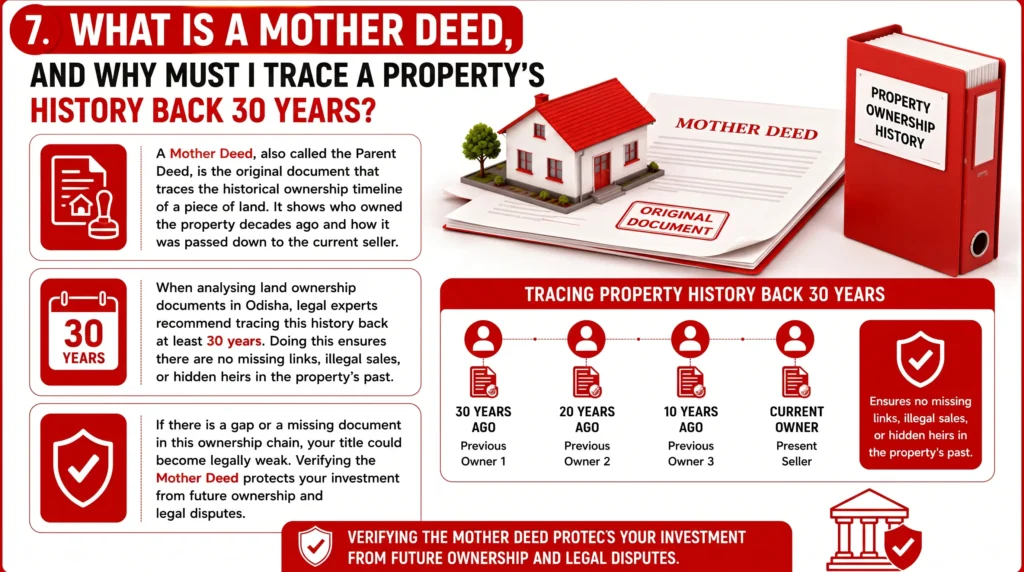
A Mother Deed, also called the Parent Deed, is the original document that traces the historical ownership timeline of a piece of land. It shows who owned the property decades ago and how it was passed down to the current seller.
When analysing land ownership documents in Odisha, legal experts recommend tracing this history back at least 30 years. Doing this ensures there are no missing links, illegal sales, or hidden heirs in the property’s past.
If there is a gap or a missing document in this ownership chain, your title could become legally weak. Verifying the Mother Deed protects your investment from future ownership and legal disputes Property Documents and Legal Terms.
8.What Is A Possession Certificate, And Does It Guarantee Legal Title?
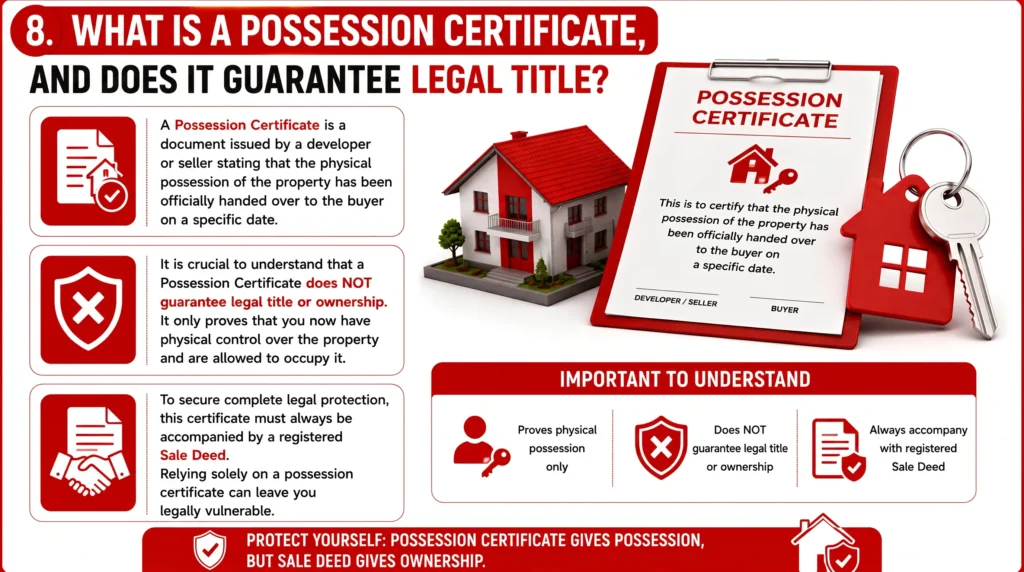
A Possession Certificate is a document issued by a developer or seller stating that the physical possession of the property has been officially handed over to the buyer on a specific date.
It is crucial to understand that a Possession Certificate does NOT guarantee legal title or ownership. It only proves that you now have physical control over the property and are allowed to occupy it Property Documents and Legal Terms.
To secure complete legal protection, this certificate must always be accompanied by a registered Sale Deed. Relying solely on a possession certificate can leave you legally vulnerable.
9.What Is A Completion Certificate (CC), And Why Should Every Homebuyer Ask For It?
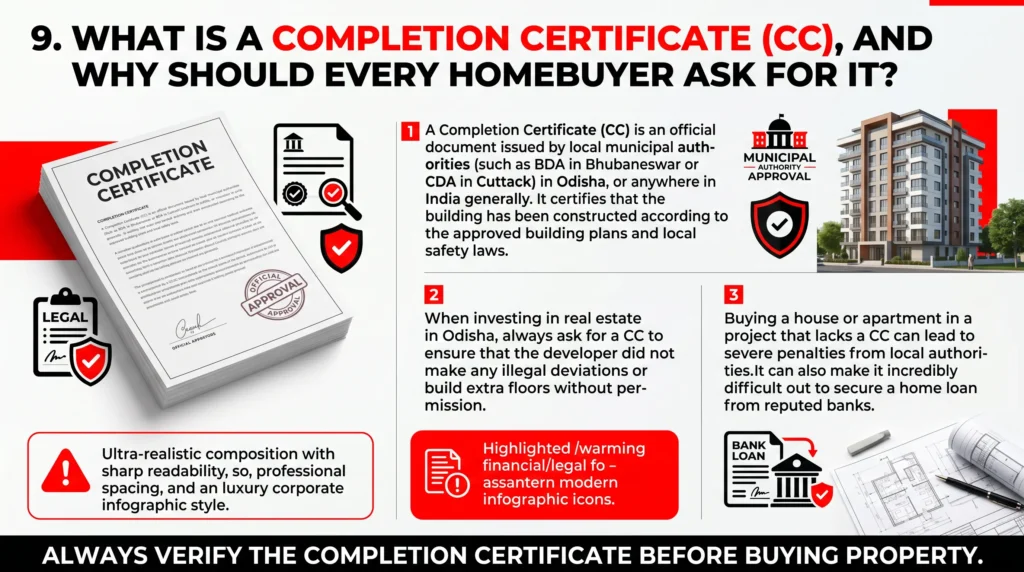
A Completion Certificate (CC) is an official document issued by local municipal authorities (such as BDA in Bhubaneswar or CDA in Cuttack) in Odisha, or anywhere in India generally. It certifies that the building has been constructed according to the approved building plans and local safety laws.
When investing in real estate in Odisha, always ask for a CC to ensure that the developer did not make any illegal deviations or build extra floors without permission.
Buying a house or apartment in a project that lacks a CC can lead to severe penalties from local authorities. It can also make it incredibly difficult to secure a home loan from reputed banks Property Documents and Legal Terms.
10.What Is An Occupancy Certificate (OC), And Is It Safe To Move Into A Building Without It?
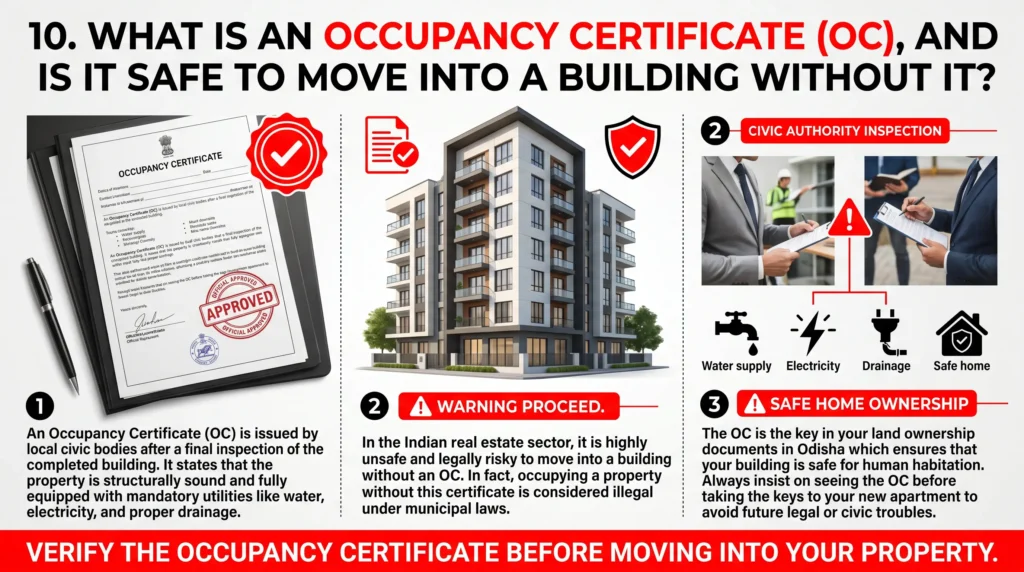
An Occupancy Certificate (OC) is issued by local civic bodies after a final inspection of the completed building. It states that the property is structurally sound and fully equipped with mandatory utilities like water, electricity, and proper drainage.
In the Indian real estate sector, it is highly unsafe and legally risky to move into a building without an OC. In fact, occupying a property without this certificate is considered illegal under municipal laws Property Documents and Legal Terms.
The OC is the key in your land ownership documents in Odisha which ensures that your building is safe for human habitation. Always insist on seeing the OC before taking the keys to your new apartment to avoid future legal or civic troubles Property Documents and Legal Terms.
11.At a Glance
| Document Name | What It Is |
| Sale Deed | The final registered agreement that legally transfers property from the seller to the buyer & Property Documents and Legal Terms. |
| Title Deed | A broad legal term for any document (like a Sale Deed or Gift Deed) that proves ownership. |
| Conveyance Deed | An umbrella term for any legal document used to transfer property rights from one person to another. |
| Agreement to Sell | A preliminary contract listing the terms, conditions, and advance payment details for a future sale. |
| RoR (Record of Rights) / Khatiyan | The official government land record in Odisha showing the current owner, plot number, and area. |
| Encumbrance Certificate (EC) | A safety report card proving the property is free from active bank loans, mortgages, or legal disputes. |
| Mother Deed | The “parent” document used to trace the continuous ownership history of the land back 30 years. |
| Possession Certificate | A letter from the seller or builder confirming that physical keys/control of the property have been handed over. |
| Completion Certificate (CC) | A certificate from local authorities (like BDA/CDA) stating the building was constructed according to approved plans. |
| Occupancy Certificate (OC) | A certificate from civic authorities stating the building is safe, legally built, and ready for human habitation. |
12.Final Words
Navigating property buying in India can feel overwhelming, but understanding these essential land ownership documents in Odisha is your best shield against property fraud. If you are buying a plot or an apartment, verify everything from the Sale Deed to the Record of Rights (RoR) to ensure your investment is completely safe Property Documents and Legal Terms.
Before closing any deal in real estate, always cross-verify your land ownership documents in Odisha through official government portals like Bhulekh and Inspector General of Registration (IGR Odisha). Taking these careful steps today guarantees a stress-free and legally secure future in your new home!
13.Frequently Asked Questions (FAQs)
1.How can I verify the current owner of a plot online before buying?
You can easily check the owner’s details, plot size, and history via the official state portal called the Bhulekh Odisha land records online. It allows you to view the digital Record of Rights (RoR) instantly. This step ensures that you are dealing with the actual legal owner and not a fraudster.
2.What should I do if the seller’s name is missing or wrong on the government portal?
If you notice any mismatch or mistake in the Bhulekh Odisha land records, the seller must first apply for a correction or mutation at the local Tehsil office. Do not proceed with the purchase if the online names do not match the physical papers. Buying a property with uncorrected records will put your registration on hold Property Documents and Legal Terms.
3.Is the digital Record of Rights (RoR) copy downloaded from the internet valid for a home loan?
The free viewable copy found in the online Bhulekh Odisha land records portal is mainly for personal verification and informational use. For official work like bank loan approvals or legal matters, you must apply for a digitally signed or certified copy. This certified document can be obtained online or through a local Jana Seva Kendra.
4.How can I make sure the physical land Patta given by the seller is genuine?
You should always cross-verify the physical document by performing a quick land patta check on the official Odisha Bhulekh website. Match the plot number, Khata number, and boundary details on the paper with the live government database. If the digital data does not match the paper copy, stop the transaction immediately Property Documents and Legal Terms.
5.How long does it take to get a liability clearance report for an Odisha property?
When you apply for an online encumbrance certificate in Odisha through the IGR portal, it is usually processed and issued within a few working days. This certificate lists all past registered transactions and confirms if the property has any active bank mortgages. It is a mandatory check to ensure you are buying a stress-free asset.
6.If I already have a registered Sale Deed, do I still need to apply for land mutation?
Yes. A registered Sale Deed transfers the property ownership to you, but mutation officially records your name in the government’s asset register. If you skip mutation, the government records will continue to show the old seller as the owner, which will create massive problems when you try to sell or pay taxes.
7.Can a builder legally force me to take possession of an apartment without an Occupancy Certificate (OC)?
No, a builder cannot legally force you to move in or take possession without a valid Occupancy Certificate. Moving into a building without an OC is considered an offense under Odisha municipal laws and means your basic utility connections could be cut off anytime. Protect your hard-earned money by waiting until the developer hands over the official OC Property Documents and Legal Terms.
8.What should I do if the seller has lost the original Mother Deed of the property?
If the original Mother Deed is missing, the current seller must file an FIR at the police station and publish a loss advertisement in local newspapers. After that, they must get a certified copy of the deed from the local Sub-Registrar’s office. Never buy a property relying solely on a basic photocopy of its past ownership history.
9.How can I check if a housing project or builder in Odisha is legally approved?
Every major real estate project in the state must be registered under the Odisha Real Estate Regulatory Authority (ORERA). You can visit the official ORERA portal to cross-verify the builder’s approvals, layout map, and construction timeline. If a project does not have an active ORERA registration number, avoid investing in it Property Documents and Legal Terms.
10.Can any Indian citizen buy agricultural land in Odisha, or are there restrictions?
Any citizen of India can purchase agricultural land in Odisha, but there are strict laws protecting lands owned by Scheduled Castes (SC) and Scheduled Tribes (ST). You cannot buy SC/ST category land unless the seller has special, written permission from the competent revenue authority (like the District Collector) Property Documents and Legal Terms.








Leave a Reply